
The $2B Question
The Cost of Spending Like We Live Somewhere Else
We like to think cities are built by policy: zoning maps, infrastructure bonds, economic development incentives. And those things matter, but they're also fragile. Policymakers turn over. Budgets balloon or collapse. Legislation passes without teeth, or gets repealed without anyone noticing.
The more durable force is behavior — the slow, habitual movement of capital, time, and attention that ultimately decides what a local economy can sustain. Those decisions don't show up on a council agenda, but they accumulate, and here in the Valley, they've been accumulating in one direction for a long time.
Roughly $2 billion in discretionary spending flows out of the 209 corridor every year. Not for work. Not for necessities. But by choice.
Every weekend, Valley residents send their dollars to someone else's city, and with those dollars go the jobs, the tax base, and the growth that could have been ours.
That this is happening isn't really a question. It already has, it is, and absent some meaningful shift, it will continue to. What's worth examining is what it would look like if even a fraction of it stopped.
Where the Money Goes
Earlier this year, we conducted what we believe to be the first published spending leakage analysis for the 209 corridor, combining Census Bureau income data, BLS consumer expenditure surveys, regional tourism reports, and mobility patterns to estimate where discretionary dollars are actually landing. To our knowledge, no formal retail leakage or economic gap study had previously been published for this region — not by the San Joaquin County CEDS, SJCOG, StanCOG, or local chambers. The San Joaquin County 2025–2030 Comprehensive Economic Development Strategy itself notes that most county businesses are "population-serving" sectors that recirculate existing dollars rather than importing new ones, but never attempts to quantify how much spending leaves. Our analysis set out to fill that gap.
The two-county region—San Joaquin and Stanislaus, roughly 1.34 million people across 417,000 households—generates an estimated $6–7.5 billion in annual discretionary spending capacity after taxes, housing, food, healthcare, and essentials. We examined leakage across nine categories: dining, retail, local events, travel, concerts, sports, weekend getaways, nightlife, and tourism.
The result: an estimated $1.8 to $2.4 billion per year in discretionary spend leaves the corridor. That’s $35 to $45 million every week in dining tabs, retail receipts, event tickets, and short trips that happen somewhere else.
Where does it go? Bay Area restaurants. Coastal hotels. Napa tastings. Big-box shopping in San Jose. Stadiums in Santa Clara. Pismo Beach, where city officials report that 80% of their 2+ million annual tourists come from the Central Valley. Santa Cruz, which lists our region as a “primary market.” San Francisco, which drew 23.1 million visitors generating $8.8 billion in 2023 alone.
The pattern is driven by compounding factors:
Geographic proximity to world-class amenities
A local entertainment and retail gap
A large supercommuter population—nearly 11% of San Joaquin County workers travel 90+ minutes each way, more than triple the national rate
And, perhaps most importantly, cultural habit. When it’s time to celebrate, to explore, to spend, Valley residents have been trained to look elsewhere.
The Dollars We Can Actually Reach
Not all of that $2 billion is gone for good. Some of it was never really in play to begin with, and understanding the difference is where the opportunity gets concrete.
To make sense of which dollars are actually recoverable, we categorized the outflow by substitutability — the degree to which spending could realistically happen locally if better options existed.
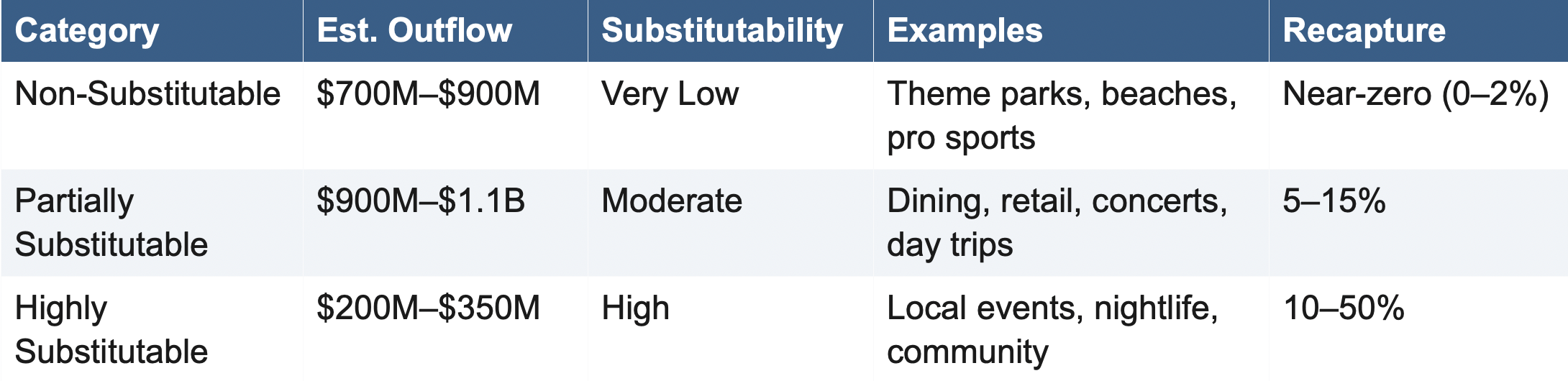
The bottom two rows represent the real opportunity surface, roughly $1.1 to $1.5 billion annually in spending that isn't driven by geography or infrastructure we can't build. It's driven by perception, packaging, and habit.
These are celebratory dinners that default to Oakland or Walnut Creek when a comparable option exists in Lodi or Modesto. Higher-end retail purchases made in the Bay not because there's nothing local, but because nothing local comes to mind. Nights out and live events that happen elsewhere because the assumption that "nothing's happening here" goes unchallenged.
What matters about this category is what it doesn't require. We're not talking about replacing beaches or building an NFL stadium. We're talking about redirecting capital that's already being spent toward options that, in many cases, already exist but haven't broken through the awareness gap.
Even a modest 5 to 10% recapture of this influenceable spending translates to $90 to $150 million a year staying within our cities, supporting local businesses, generating tax revenue, and creating an estimated 1,500 to 2,000 direct jobs (based on BEA employment-to-output ratios for retail, food service, and entertainment in the San Joaquin Valley). That kind of sustained local reinvestment also sends a signal to outside investors and developers that the Valley is a market worth entering, which begins to close the gap that caused the leakage in the first place.
And none of that requires a legislative act. The mechanism is behavioral.
What No Bond Measure Can Buy
The relationship between local spending and local economic health isn't linear — it compounds. When a restaurant survives its first two years because enough locals chose it for a birthday dinner instead of driving to the Bay, that business hires more staff, builds a reputation, and eventually becomes the kind of place that draws visitors from outside the region. A single pattern of behavioral shift, repeated across enough households and enough weekends, turns into a durable economic asset.
The same logic applies across categories. A local event that consistently draws a crowd generates vendor revenue, media coverage, and a kind of civic confidence that changes how residents talk about where they live. That shift in narrative isn't cosmetic. It changes the next spending decision, which changes the next business case, which changes what gets built.
Recaptured capital doesn't just stay — it sticks. It creates jobs, venues, and the kind of cultural gravity that makes a place feel like it's going somewhere. Over a decade, that compounding effect is the difference between a region that functions as a bedroom community for the Bay and one that people actively choose as a destination. No bond measure can manufacture that kind of momentum; it has to be earned through thousands of individual decisions that, taken together, reshape what the local economy can support.
Right now, the optimism-to-economics ratio in the Valley is off. We have the spending power and we have the population. What we don't yet have is the widespread belief that reinvesting locally is worth it, or the coordinated effort required to make that belief feel justified. Building that confidence is the work — and it starts with making the case, in concrete terms, that the money is already here and the only question is where we point it.
So Whose City Are We Building
Most people don't think of themselves as investors in their local economy, but that's what they are. Every dinner out, every retail trip, every weekend plan is a capital allocation decision, and Valley residents are collectively making about $2 billion worth of them every year. The 209 doesn't have a spending problem. It has a direction problem.
Fixing that doesn't require new legislation, a coastline, or a professional sports franchise. It requires better information about what's already here and what's worth showing up for, and the kind of infrastructure that makes choosing local feel obvious rather than effortful.
The $2 billion question was never about whether the money exists. It's about whose city it builds.
About This Analysis
This article draws from an economic leakage analysis of California’s 209 corridor, synthesizing data from the U.S. Census Bureau American Community Survey (2023), Bureau of Economic Analysis regional income accounts (2023), Bureau of Labor Statistics Consumer Expenditure Survey (2024), San Joaquin County CEDS (2025), SJCOG supercommuter statistics, San Francisco Travel Association visitor data (2023), TEA/AECOM Theme Index (2024), Visit Santa Cruz County economic impact data (2023), and Pismo Beach city official statements. Full methodology and source citations are available upon request.